Friday, November 11, 2022


Tuesday, December 21, 2021

Wednesday, December 15, 2021
Wednesday, November 3, 2021
WOUND BALLISTIC REVIEW JOURNAL OF THE INTERNATIONAL WOUND BALLISTICS ASSOCIATION Simplified Bullet Testing



WOUND BALLISTIC REVIEW
JOURNAL OF THE INTERNATIONAL WOUND BALLISTICS ASSOCIATION
SIMPLIFIED BULLET EFFECT TESTING
Martin L. Fackler MD, Wound Ballistics Consultant, Hawthorne, FL Abstract
PURPOSE: To describe a simple and inexpensive test for handgun bullet performance
METHOD: Bullets are fired through a single halfgallon cardboard milk carton filled with water, backed by a twenty-six-inch long cardboard box filled with unspun cotton fibers.
RESULTS: The four inches of water causes a handgun bullet to expand as it does in living tissue. Then the cotton fiber material wraps around the bullet and stops it from recovery while causing it no additional deformity
CONCLUSION: The resistance to a bullet's penetration in water mimics closely the deformation-causing potential in living softtissue. Unspun cotton fibers capture a bullet without causing it to deform or fragment. Since the cotton can be reused indefinitely, only a single onehalf gallon milk carton needs to be replaced for each new shot.
Ordnance gelatin mixed in a 10% by weight solution and shot at a block temperature of 4°C has become the standard for reliable and reproducible testing of bullet effects. Each block of the gelatin must be calibrated before test shots by shooting a steel BB into it at 590 ft/sec. A BB penetration of 8.5±1 cm is the standard that verifies that the gelatin will reproduce the approximate penetration depth seen in living muscle. Shots into standard ordnance gelatin reproduce bullet expansion and fragmentation pattern, bullet penetration depth, temporary cavity size and location, and the yaw behavior of the bullet. Ordnance gelatin, however, is expensive. Preparing it properly and using it correctly are time-consuming and demand great attention to detail.
Shots into water cause bullets to expand as they do in gelatin or muscle.' Water-filled tanks are used almost universally for recovering test bullets in criminalistics laboratories. We have published an article describing a method for shooting into a homemade water tank. 2 In general, however, water tanks are expensive and bulky, and tanks are justified only where a lot of bullet testing is done. In 1990, IWBA member Gus Cotey published an article describing a "poor man's ballistics lab" in which he fired into lined-up water-filled cardboard milk or juice cartons.' More recently, Gus published a follow-up article describing the limitations of water-filled cartons in predicting bullet penetration distance.4 Another recent article, in which water-filled cartons were used to test rifle bullets,' illustrated the inconvenience of having to use up to 16 cartons to assure capturing the test bullet.
In any method of testing bullet performance, recovering the test bullet is mandatory. FMJ rifle bullets have a strong tendency to change their direction of travel considerably when they yaw in water, gelatin, or the human body. This causes a problem in gelatin and in water testing since yawing bullets often exit the sides of the test mediUm and are lost. Hagen had to add more cartons on the sides of his lined-up central cartons to increase the chances of catching the 5.45x39 mm bullet he tested, which acted like an FMJ bullet, yawed and changed its direction of penetration.'
Although soft-point or hollow-point expanding bullets nearly always penetrate in a straight path, in gelatin, water, or living tissue, after they expand, there must be enough tissue simulant to encompass the entire bullet path. Most bullets will penetrate about 1.5 times as far in water as in standard 10% ordnance gelatin: some penetrate even farther. This adds inconvenience by increasing the number of cardboard cartons needed to capture the test bullet. To capture an expanding handgun bullet, that expands, six lined-up cartons should suffice. But the reason for the testing is most often to find out if the bullet expands or not. If the bullet does not expand, twelve lined-up cartons might be needed to capture it.
The purpose of this paper is to describe a simple and inexpensive test of bullet effects, which requires only one carton per shot, in hopes, it will encourage more widespread use of bullet testing.
METHOD
Figure one shows a 26-inch long, 17 inches wide, and nine-inch high-corrugated cardboard box, which has been divided in half, lengthwise, by stapling in place a 1/2-inch fiberboard divider. This produces two eight by nine-inch channels, each 26 inches long. These channels can be divided by corrugated cardboard spacers, from four to seven inches apart, as shown, which are held in place by the unspun cotton fiber material filling the spaces between them.
One Winchester 147 grain hollow-point bullet was fired, from a 9mm Parabellum Browning HiPower handgun, directly into the right-side channel of the cotton-filled box.
Another Winchester 147 hollow-point bullet from the same lot was fired from the same 9mm Parabellum Browning HiPower handgun through a water-filled half-gallon cardboard milk carton placed two inches in front of the right-side channel of the cotton-filled box. That bullet passed through the water-filled carton and then into the cottonfilled box.
For both shots, the box was placed about ten feet from the handgun's muzzle, and the light-sensing screens of an Oehler Model 35 chronograph were placed a few feet in front of the box.
Although not shown in Figure one, the water-filled carton is shot after it is placed in a lightweight plastic bag considerably larger than the carton. This bag helps greatly in controlling the water which, propelled by the force of the temporary cavity, leaves the disrupted carton and spreads water over a six to ten-foot radius without the bag.
RESULTS
The velocity of the bullet that passed directly into the cotton-filled box was 1042 ft/sec. It was recovered, undeformed, after having penetrated 23 inches into the cotton. The undeformed bullet is shown on the left side of Figure two.
The velocity of the bullet that passed through the water-filled carton before entering the cotton-filled box was 997 ft/sec. It was recovered after penetrating 15 inches into the cotton fibers. It had expanded to a diameter of 0.56 inches and had five sharp edges of folded-back copper bullet jacket strips protruding from the bullet's expanded diameter as viewed from front to back. This bullet is shown on the right side of Figure two.
In Figure one, a disrupted half-gallon milk carton, through which the bullet that expanded passed, is shown a few inches in front of the cotton-fiber-filled box.
Previous unreported testing has shown the cotton or polyester material has another advantage that is evident when capturing rifle bullets: when the rifle bullet yaws in this material (as shown by the shape of holes in the spacers, it does not change the direction of its penetration. This makes FMJ rifle bullets far easier to capture in cotton or polyester fiber than they are in gelatin or water, where they do change direction as they yaw. Based on my previous testing, the M193 bullet, fired from an M16A1 rifle, is likely to require seven or eight feet of polyester pillow stuffing to capture it. But since the bullet travels straight, a six-by-six inch channel is probably adequate to capture these rifle bullets -- provided the shots are kept in the center of the channel and the boxes are lined up squarely.
DISCUSSION
The hybrid test method described here combines water, a tissue simulant that causes a bullet to expand as it does in living soft tissue, with cotton, a material used to capture test bullets without deforming them. We know from testing bullets in gelatin that if an expanding-type handgun bullet is going to expand it will do so within a few inches of entry into the gelatin, where its velocity is highest. Thus, the four inches of water in the carton is sufficient to expand any bullet that is, going to expand. After the water, all that is needed is a material to capture the bullet without changing it further. Unspun cotton fibers, by wrapping around the spinning bullet, stop it in a shorter distance than does further penetration into the water. The great advantage of cotton, however, is that it is reusable practically indefinitely. After every few shots, it is useful to repair holes made in the cardboard spacers by previous bullets. These spacers are not essential to the method reported here, but aid in finding the fired bullets rapidly.
It should be noted that unspun cotton fiber is not currently easy to obtain. It appears to have been essentially replaced for padding in clothing, quilts, or comforters, by polyester fiber. I could not
locate uspun cotton fiber in Gainesville, FL, and had to order it over the internet (www.halcyonyam.com). Based on a few comparison shots, it appears that the easier-to-find polyester pillow stuffing can be used interchangeably with cotton as a medium for catching bullets without deforming them.
To estimate the effectiveness of any expanding-type handgun bullet, its expanded diameter, and the depth to which it penetrates must be known. Bullet expansion and penetration are related inversely: for bullets of the same caliber and weight, the larger a bullet's expanded diameter, the shallower its penetration depth. The test described here reveals a bullet's expanded diameter. A bit of experience testing bullets in gelatin, a perusal of some of the wound profiles shown in this issue (pp.25-38) or results from published studies reporting testing of bullets in gelatin, will allow accurate estimation of the penetration depth for a bullet, given its caliber, weight, and expanded diameter.
CONCLUSION
The calibration and standardization of ordnance gelatin was done in the mid-1980s. Since then the quality and reliability of handgun bullets has increased greatly. Outlandish advertising claims become less likely when a reliable test is available to disprove them. But there is still the problem of quality control. From time to time a lot of ordinarily reliable bullets are produced which fail to perform as they should. The more widespread the availability of valid bullet testing, the more likely it is that substandard bullets will have their defects exposed before they can endanger the lives of their users.
The bullet test described here is especially applicable to exposing: unsatisfactory expansion of handgun bullets. This test method is simple and inexpensive enough so that serious users of handgun bullets, whose life might depend upon the reliability of these bullets, can test their own bullets without great inconvenience. This makes the user independent of possibly unreliable tests done by others or by the bullets' manufacturer.
This simple and reliable bullet testing method in the hands of all serious shooters should, over time, increase the overall quality of available bullets.
ACKNOWLEDGEMENT
The basic idea for the hybrid test reported here came from Mr. Merrill Martin, avid shooter
and innovative firearm technology experimenter (and developer of the now widely used molybdenum disulfide bullet coating), of Emeryville, CA. The use of two different materials in the same bullet test is based on a test he described to me. He simulates a small animal with a plastic container, filled with a mud used to lubricate oil drills. He then catches the bullet as it exits in hs ten-foot-long box filled with oiled sawdust. He then finds the bullet using a metal detector. Oiled sawdust is te other material, in addition to unspun cotton fiber, that can be used to catch bullets without deforming them in the process.
References
I . Fackler ML. Police Handgun Ammunition Selection. Wound Ballistics Rev, 1 992; I (3):32-37.
2. Jones RL. Water Testing .38 Special +P Hollow Points. Wo11nd Ballistics Rev 1997;3( I ): 1 3 - 1 6 .
3 . Cotey G. A poor man's ballistics lab. Rifle 1 990; 1 28 : 1 8-2 1 &43.
4. Cotey G. The Limitations of Water-filled Cardboard Cartons in Predicting Bullet Penetration. Wound Ballistics Rev 1 999;4( I ):30-35.
5. Hagen M. 5.45x39 MM JHP Ammunition for the AK-74. Wound Ballistics rev 200 I ;5( I ); 1 7-22.
6. Dahlstrom DB, Powley KD. Comparative Performance of 9mm Parabellum, .38 Special, and .40 Smith & Wesson Ammunition in Ballistic Gelatin. Wound Ballistics Rev 1 996;2(3 ):8-28.
7. Results from bullet testing in 10% Ordnance Gelatin available from the Fireams Training Unit of the FBI Academy, Quantico,
VA (from about 1990 until the present).
8. Mann FW, MD. The Bullet 's Flight from Powder to Target. New York, Munn & Co, 1909. pp 59-60.
Tuesday, April 13, 2021

Saturday, April 3, 2021
Thursday, November 19, 2020
Saturday, November 14, 2020
California Officers Respond To Dude With A Hammer
If this were suicide by cop, why would they want to give him what he wanted with a shot into vital organs?
Wednesday, November 11, 2020
.22 Shorts - Don't let their "cuteness" fool you
The .22 Short Super X had 74 foot pounds of force. That is equal to a 149 gram baseball being thrown at 82 mph. A 650 grain arrow delivers 54.9 ft./lbs from a 70 pound bow. Far less has been used to kill 500 pound bears. Bella Twin was a Cree woman who used a .22 long in a .22 caliber single shot Cooey Ace 1 with a 17 inch barrel - a full 1.5 inches shorter than your Ruger 10/22.
Saturday, November 7, 2020
Wednesday, May 7, 2014
Despite controversy concerning their safety, use of electrical stun guns (Tasers) by law enforcement agencies is increasing.
Tasering Taxpayers to Death in Salem
FOX-12 showed video this week of a Salem Police officer confronting a skateboarder at the Salem Transit Mall, then shooting him with a taser in a way that seems extremely unnecessary. Police are being tight lipped about it, they admit an internal investigation was launched, so the police are policing the police....
FOX-12's Jamie Wilson says, "Salem officials tell us they can't talk about that because the details are part of their internal affairs investigation." It happened on 18 April 2014.
Taser use by officer on skateboarder under investigation
KPTV - FOX 12
Am J Cardiol. 2009 Mar 15;103(6):877-80. doi: 10.1016/j.amjcard.2008.11.046. Epub 2009 Jan 21.
Relation of Taser (electrical stun gun) deployment to increase in in-custody sudden deaths.
Abstract
Despite controversy concerning their safety, use of electrical stun guns (Tasers) by law enforcement agencies is increasing. We examined the effect of Taser deployment on rates of (1) in-custody sudden deaths in the absence of lethal force, (2) lethal force (firearm) deaths, and (3) officer injuries (OIs) requiring emergency room visits. Under the Public Records Act and the Freedom of Information Act, 126 police and sheriff departments from California cities were mailed surveys requesting rates of each of the outcomes of interest for each of the 5 years preceding Taser deployment through the 5 years after deployment. To control for population size and crime rates, we used total annual arrests per city as reported to the Department of Justice. Fifty cities provided predeployment and postdeployment data on in-custody sudden death, 21 cities reported firearm deaths, and 4 cities reported OIs. The rate of in-custody sudden death increased 6.4-fold (95% confidence interval 3.2-12.8, p = 0.006) and the rate of firearm death increased 2.3-fold (95% confidence interval 1.3-4.0, p = 0.003) in the in the first full year after Taser deployment compared with the average rate in the 5 years before deployment. In years 2 to 5 after deployment, rates of the 2 events decreased to predeployment levels. We observed no significant change in the rate of serious OIs after Taser deployment. In conclusion, although considered by some a safer alternative to firearms, Taser deployment was associated with a substantial increase in in-custody sudden deaths in the early deployment period, with no decrease in firearm deaths or serious OIs.
http://www.ncbi.nlm.nih.gov/pubmed/19268749
Prehosp Emerg Care. 2006 Oct-Dec;10(4):447-50.
Taser use in restraint-related deaths.
Abstract
OBJECTIVE:
The Taser is an electric weapon capable of releasing significant amounts of electricity in rapid pulses, causing uncontrollable muscle contraction. Use of this weapon has dramatically increased over the past decade, and it is now commonly used by law enforcement officers nationwide. Emergency medical services providers are, likewise, seeing more patients who have recently been subjected to application of a Taser. We examined the autopsy reports of patients who died after application of a Taser in an attempt to identify high-risk interactions.
METHODS:
This is a case series of Taser-related deaths. Fatalities occurring over four years beginning in January 2001 were identified through an Internet search, and autopsy reports were requested. Reports were analyzed for patient demographics, preexisting cardiac disease, toxicology, evidence of excited delirium, restraint techniques used, and listed cause of death.
RESULTS:
Of 75 cases identified, 37 (49.3%) had autopsy reports available for review. All cases involved men, with ages ranging from 18 to 50 years. Cardiovascular disease was found in 54.1%. Illegal substance use was found on toxicology screening for 78.4%; within that group, 86.2% were found to have been using stimulants. A diagnosis of excited delirium was given for 75.7% of the cases. Use of a Taser was considered a potential or contributory cause of death in 27%.
CONCLUSIONS:
This is the largest review of Taser-related fatalities reported in the medical literature. The findings are consistent with prior studies, suggesting a high frequency of restraint-related and excited delirium-related fatalities.
http://www.ncbi.nlm.nih.gov/pubmed/16997772
Friday, July 26, 2013
An Alternate Look at Handgun Stopping Power
The data for this was taken from:
"An Alternate Look at Handgun Stopping Power" by Greg Ellifritz
Greg Ellifritz is the full time firearms and defensive tactics training officer for a central Ohio police department. He holds instructor or master instructor certifications in more than 75 different weapon systems, defensive tactics programs and police specialty areas. Greg has a master's degree in Public Policy and Management and is an instructor for both the Ohio Peace Officer's Training Academy and the Tactical Defense Institute.
Using the . 22 for Self Defense
Using the
It is a compilation of stopping power results from every shooting he could find. He talked to the participants of gunfights, read police reports, attended autopsies, and scoured the newspapers, magazines, and Internet for any reliable accounts of what happened to the human body when it was shot. Suggested reading is: Handgun Stopping Power: The Definitive Study by Evan P. Marshall

Greg Ellifritz, is assuming the original target here is the head or torso and there seems to be no attempt to claim the head hit is the brain / medulla oblongata and the torso hit is the heart or lungs.
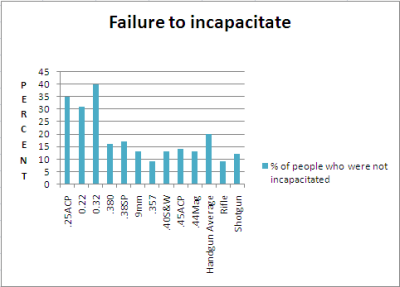
Obviously, this represents shooters who stop shooting before the aggressor is incapacitated or independent shots . If you have to shoot an intruder, many recommend a controlled pair of rounds. My rule for self defense against an aggressor, is accept and expect to the rule of three: three yards, three seconds, and three shots for a successful self defense.

Greg Ellifritz says, " I reported the data I have, but I really don't believe that a . 32 ACP incapacitates people at a higher rate than the . 45 ACP!"
While that is a conservative statement that is more popular, it does not explain the data. Given what I know about pain, a sudden large trauma leads to a huge dump of endorphins , of which enkephlin is the main one. The smaller the trauma, the more likely they will feel the pain sooner.
If you think about it, knowing you were shot by a . 45 is certainly not going to feel more like getting shot than being shot with a . 22, which is the necessary converse of that logic. People who feel no pain will keep coming at you, even if they have a mortal wound.
I have an example: In the 1986 FBI Miami shootout, Platt, who killed two and wounded two, was killed with the first shot, from a 9mm through his right arm, his lung, and stopping next to his heart. AFTER THAT, he took 11 more shots/wounds. While the mortal wound was taking effect, he fired one handed with his left hand emptying his Mini-14 [10 shots?] and five rounds from his shotgun.

PERCENT INCAPACITATED BY ONE SHOT TO TORSO OR HEAD:
47%-9mm Lugar49%-
51%-
52%-
53%-
55%-
60%-
61%-
62%-
72%-.32
80%-All Center Fire Rifles
86%-Shotguns, 90% of which were 12 gauge.

Number of Rounds To Incapacitate:
2.45 rounds-9mm Lugar
2.36 rounds-. 40 S&W
2.20 rounds-. 25 ACP
2.08 rounds-. 45 ACP
1.86 rounds-. 38 Special
1.76 rounds-. 380 ACP
1.71 rounds-. 44 Magnum
1.70 rounds-. 357 Magnum or Sig
1.52 rounds-. 32
1.40 rounds-typical center fire rifle
1.38 rounds-. 22 LR, Long, or Short
1.22 rounds-typical Shotgun, 90% of which are 12 gauge
Obviously, the fewer rounds it takes to incapacitate, the better.

One-Shot-Stop Percentage
30%-. 25 ACP
31%-. 22 LR, Long, Short
34%-9mm Luger
39%-. 38 Special
39%-. 45 ACP
40%-32 Long, ACP
44%-. 380 ACP
44%-. 357 Magnum and Sig
45%-. 40 S&W
58%-Rifle/All Centerfire
58%-Shotgun( All/90% 12 gauge)
59%-. 44 Magnum
Percentage of Hits Fatal:
21%-. 32 LONG, ACP
24%-9mm Luger
25%-40 S&W
25%-. 25 ACP
26%-. 44 Magnum
29%-. 380 ACP
29%-. 38 Special
29%-. 45 ACP
34%-. 22 LR, LONG, SHORT
34%-. 357 (Magnum & Sig)
65%-Shotgun( All/90% 12 gauge)
68%-Rifle( All Centerfire)
Accuracy( Head/Torso hits)
62%-. 25 ACP
74%-9mm Luger
76%-. 22 Short/Long/LR
76%-. 380 ACP
76%-. 38 Special
76%-. 40 S&W
78%-. 32 Long/ACP
81%-. 357 (Magnum/Sig)
81%-Rifle( Centerfire)
84%-Shortgun( 90% 12 Gauge)
85%-. 45 ACP
88%-. 44 Magnum
Percentage of People Not Incapacitated
40%-. 32 Long, ACP
35%-. 25 ACP
31%-. 22 LR, Long, Short
17%-. 38 Special
16%-. 380 ACP
14%-. 45 ACP
13%-9mm Lugar
13%-. 40 S&W
13%-. 44 Magnum
12%-Shotgun( All, 90% 12 Gauge
9%-. 357( Magnum & Sig)
9%-Rifle( centerfire )
. 25 ACP
# of people shot - 68
# of hits - 150
% of hits that were fatal - 25%
Average number of rounds until incapacitation - 2.2
% of people who were not incapacitated - 35%
One-shot-stop % - 30%
Accuracy (head and torso hits) - 62%
% actually incapacitated by one shot (torso or head hit) - 49%
.22 (short, long and long rifle)
# of people shot - 154
# of hits - 213
% of hits that were fatal - 34%
Average number of rounds until incapacitation - 1.38
% of people who were not incapacitated - 31%
One-shot-stop % - 31%
Accuracy (head and torso hits) - 76%
% actually incapacitated by one shot (torso or head hit) - 60%
. 32 (both. 32 Long and. 32 ACP)
# of people shot - 25
# of hits - 38
% of hits that were fatal - 21%
Average number of rounds until incapacitation - 1.52
% of people who were not incapacitated - 40%
One-shot-stop % - 40%
Accuracy (head and torso hits) - 78%
% actually incapacitated by one shot (torso or head hit) - 72%
. 380 ACP
# of people shot - 85
# of hits - 150
% of hits that were fatal - 29%
Average number of rounds until incapacitation - 1.76
% of people who were not incapacitated - 16%
One-shot-stop % - 44%
Accuracy (head and torso hits) - 76%
% actually incapacitated by one shot (torso or head hit) - 62%
9mm Luger
# of people shot - 456
# of hits - 1121
% of hits that were fatal - 24%
Average number of rounds until incapacitation - 2.45
% of people who were not incapacitated - 13%
One-shot-stop % - 34%
Accuracy (head and torso hits) - 74%
% actually incapacitated by one shot (torso or head hit) - 47%
. 38 Special
# of people shot - 199
# of hits - 373
% of hits that were fatal - 29%
Average number of rounds until incapacitation - 1.87
% of people who were not incapacitated - 17%
One-shot-stop % - 39%
Accuracy (head and torso hits) - 76%
% actually incapacitated by one shot (torso or head hit) - 55%.357 (both magnum and Sig)
# of people shot - 105
# of hits - 179
% of hits that were fatal - 34%
Average number of rounds until incapacitation - 1.7
% of people who were not incapacitated - 9%
One-shot-stop % - 44%
Accuracy (head and torso hits) - 81%
% actually incapacitated by one shot (torso or head hit) - 61%
.40 S & W
# of people shot - 188
# of hits - 443
% of hits that were fatal - 25%
Average number of rounds until incapacitation - 2.36
% of people who were not incapacitated - 13%
One-shot-stop % - 45%
Accuracy (head and torso hits) - 76%
% actually incapacitated by one shot (torso or head hit) - 52%
.45 ACP
# of people shot - 209
# of hits - 436
% of hits that were fatal - 29%
Average number of rounds until incapacitation - 2.08
% of people who were not incapacitated - 14%
One-shot-stop % - 39%
Accuracy (head and torso hits) - 85%
% actually incapacitated by one shot (torso or head hit) - 51%
.44 Magnum
# of people shot - 24
# of hits - 41
% of hits that were fatal - 26%
Average number of rounds until incapacitation - 1.71
% of people who were not incapacitated - 13%
One-shot-stop % - 59%
Accuracy (head and torso hits) - 88%
% actually incapacitated by one shot (torso or head hit) - 53%
Rifle (all Centerfire)
# of people shot - 126
# of hits - 176
% of hits that were fatal - 68%
Average number of rounds until incapacitation - 1.4
% of people who were not incapacitated - 9%
One-shot-stop % - 58%
Accuracy (head and torso hits) - 81%
% actually incapacitated by one shot (torso or head hit) - 80%
Shotgun(All,but 90% of results were 12 gauge)
# of people shot - 146
# of hits - 178
% of hits that were fatal - 65%
Average number of rounds until incapacitation - 1.22
% of people who were not incapacitated - 12%
One-shot-stop % - 58%
Accuracy (head and torso hits) - 84%
% actually incapacitated by one shot (torso or head hit) - 86%
NOTEWORTHY ROUNDS
111 ft/lbs .32 Auto Underwood 50gr Xtreme Cavitator 50 grain 1000 fps120 ft/lbs .22 Aguila SSS 22 LR 60 grain 950 fps UPC:640420001357
150 ft/lbs .25 ACP MagSafe Handgun Cartridge 22 Grain Defender Bullet 1750 fps
161 ft/lbs. .32 ACP Buffalo Bore .32 ACP +P 60 Grain TAC-XP 1100 fps UPC:651815030029
183 ft/lbs .22 CCI Velocitor 22 LR 40 grain 1435 fps UPC:076683000477
191 ft/lbs .22LR 32 grain CCI Stinger 1640 fps 885360078
192 ft/lbs 22LR 40 grain Aguila Interceptor 1470 fps 640420001449
204 ft/lbs .22 Aguila Super Maximum Ammunition 30 Grain 1750 fps UPC:640420001012
212 ft/lbs Remington Rimfire Ammo Yellow Jacket 22LR HP 33 Grain 1700 fps UPC047700481104
215 ft/lbs G2 Research .380 ACP Ammunition RIP Out, HP, 62 Grains 1250fps UPC:863552000016
220 ft/lbs .32 ACP Buffalo Bore 75 Grain Hard Cast Flat Nose Bullet 1150 fps UPC:651815030012
243 ft/lbs 380 Auto +P 70gr Grizzley Xtreme 1250 fps UPC 815152011244
244 ft/lbs Polycase Inceptor .380 ACP 56 Grain Cu/Polymer ARX 1400 fps UPC:813412020296
244 ft/lbs Underwood .380 ACP Xtreme Defender FTM 65 Grains 1300 fps UPC:816874020040
255 ft/lbs Buffalo Bore .380 ACP +P 80 gr TAC-XP HP 1200fps UPC:651815027081
277 ft/lbs Buffalo Bore .380 ACP +P 95 Grain FMJ-Flat Nose 1140 fps UPC:651815027029
277 ft/lbs 380 Auto +P Ammo - 100 gr. Hardcast F.N. 1150fps
296 ft/lbs .380 ACP +P Buffalo Bore 90 Grain JHP Bullet 1218 fps
312 ft/lbs Armscor USA .22 TCM JHP,40 Grain 1875 fps UPC:812285020013
346 ft/lbs Armscor USA .22 TCM 9R 39 Grain JHP2000 fps UPS:812285021751
375 ft/lbs .32 H&R Magnum +P Buffalo Bore Heavy 100 Grain JHP 1300 fps
431 ft/lbs 9mm +P+ Buffalo Bore Barnes TAC-XP HP 115Grain Lead Free 1400fps
436 ft/lbs MagSafe .357 MAG, 37 Gr 2300 fps UPC:013964223279
450 ft/lbs 9mm +P Liberty Civil Def,50 Gr CU Frag HP 2000 fps UPC: 696859105623
465 ft/lbs Magsafe .357 Mag, 70 GR, 1730 fps, UPC:013964223262
484 ft/lbs .45 +P Buffalo Bore 255 gr. Hard Cast Flat Nose 925 fps
497 ft/lbs .45 +P Buffalo Bore 185 gr. TAC-XP Hollow Point 1100 fps
500 ft/lbs. 9mm +P+ Buffalo Bore 115 Grain JHP Bullet 1426 fps UPC:651815024011
500 ft/lbs .40 S&W Liberty Civil Defense 60 Grain Copper HP 2000 fps UPC:696859085444
528 ft/lbs Magsafe 9mm Luger 45 grains Pre-frag 2300 fps UPC: 013964223354
548 ft/lbs .38 Special+P Buffalo Bore 158 Grain Kieth Hard Cast 1250 fps UPC:6518150202805
560 ft/lbs.45 Long Colt Fragmenting HP 78 Grains 1800 fps UPC: 748252054975
567 ft/lbs .40 S&W DoubleTap DT Defense 135 Grain Nosler JHP 1375fps UPC:091037282194
575 ft/lbs.357 SIG CorBon Self Defense 115 Grain JHP Bullet 1500 fps
588 ft/lbs .45 ACP +P MagSafe Defender Frangible 96 Gr 1660 fps UPC:013964223224
600 Ft/lbs Buffalo Bore .45 ACP +P 160Grain TAC-XP HP 1300 fps UPC:651815451602
604 ft/lbs .40 S&W MagSafe Defender Pre Frag 84 Grain 1800 fps MAG40D8 UPC:013964223132
616 ft/lbs .45 +P Atomic Ammunition 185 grains 1225 fps UPC 858767004584
651 ft/lbs .410 Bore Winchester Super-X 2-1/2" HP Rifled Slug 1/5 Ounce 1830 fps UPC:020892000438
763 ft/lbs .357 Magnum Buffalo Bore 158 Grain JHP 1475 fps UPC:651815019239
710 ft/lbs 10MM DoubleTap DT Tactical 125 gr. 1600 fps UPC:910372820338
770 ft/lbs 10mm Auto Liberty, CHP, 60 Grains 2400 fps UPC:748252054982
781 ft/lbs .410 Brenneke USA 3" Rifled Slug Lead 1/4 oz 1755 fps UPC:4030128360287
802 ft/lbs .357 Magnum Buffalo Bore 125 Grain JHP 1700 fps UPC 651815019246
925 ft/lbs 357 magnum Armscor USA, FMJ, 125 Grain 1826 fps UPC: 812285020068
1151 ft/lbs .45 Long Colt +P DoubleTap 360 gr Hardcast Flat Nose 1200 fps UPC:091037282590
1307 ft/lbs .357 Magnum ARMSCOR 357MAG 158GR FMJ 1826 fps UPC 812285020075
1698 ft/lbs .44 Magnum +P+ Buffalo Bore 340 Grain 1478 fps UPC:651815004242
1759 ft/lbs Hornady .22-250 Remington 35 grains 4450 fps UPC:090255383348
1976 ft/lbs Remington 20 Ga Premier AccuTip 2-3/4" Bonded Sabot Slug, 260 Gr 1850 fps UPC:047700506906
2141 ft/lbs 12 Ga Winchester 2-3/4" BB Steel 1-1/8 Ounce 1400 fps UPC:020892017160
2470 ft/lbs 20 Ga Lightfield Hybred Mag-20 7/8 Ounce Lead Sabot Slug 1700 fps UPC:784268061439
2480 ft/lbs Kent Fasteel 12 Ga 2.75"#1Steel 1.0625oz 1550 fps UPC 656308200019
2480 ft/lbs Kent Cartridge Fasteel 12 Ga 2.75" BB Steel 1.0625oz 1550 fps UPC:656308200002
2569 ft/lbs Federal Mag-Shok 12 Gauge 3" #5 Copper Plated 2oz 1150fps UPC: 029465028220
2624 ft/lbs Federal Speed-Shok 12 Ga 3" T Steel 1.125 oz 1550 fps UPC:029465027865
2624 ft/lbs Federal Speed-Shok 12 ga 3" BB Steel 1.125 oz 1550 fps UPC:029465023874
2664 ft/lbs. muzzle Hornady SST 12 Gauge 2.75" 300 gr FTX Sabot 2000 fps UPC:090255386233
2700 ft/lbs Liberty Animal Instinct .308 100 grain 3500 fps UPC:019962272431
2800 ft/lbs Buffalo Bore 308 150 grain 2900 fps UPC:651815039015
2871 ft/lbs Nosler Trophy .308 Winchester 165 gr 2800 fps UPC:054041400633
2883 ft/lbs PPU .30-06 SPRG 170 Grain 2805 fps UPC:8605003800897
2918 ft/lbs Hevi-Shot Hevi-Steel 12 Ga 3" #1 Steel 1.25oz 816383600016
2997 ft/lbs HSM Trophy Gold .308 210 Grain 2530 fps UPC:837306006548
3008 ft/lbs Hornady Superperformance match .308 2840fps UPC:090255809633
3510 ft/lbs Remington HyperSonic 12Ga 3"#1Steel 1.25oz 1700 fps UPC 047700510101
3510 fps Remington HyperSonic 12 Ga 3" BB Steel 1.25oz 547 gr 1700 fps UPC:047700510002
3856 fps Remington HyperSonic 12 Ga 3.5" BB Steel 1.375oz 601 gr 1700 fps UPC:047700510408
3747 ft/lbs Brenneke USA, 12 Gauge Magnum,3",1.5 oz.Slug UPC 4030128120522
4759 ft/lbs 12 Gauge LightfieldCommander IDSPlus Sabot Slug 3-1/2" 1-3/8 Oz 1890 fps UPC:784268824638
13688 ft/lbs PMC Bronze .50 BMG 660 Grain FMJBT 3080 fps UPC:741569060356
48000 ft⋅lbf 20mm Vulcan(20×102mm),2000 grain,3300 fps 2000 grain/4.6 oz.
BASEBALL BALLISTICS
Baseball diameter=7.6 cm
Baseball radius=3.8 cm
Baseball volume=229 cm
Baseball weight=149 grams
89 ft/lbs: Baseball(Pitch) @ 90mph/132 fps
120 ft/lbs: Aguila SSS Sniper Subsonic Ammunition 22 Long Rifle 60 Grain 950 fps
186 ft/lbs: Baseball(Hit)130mph/190 fps
204 ft/lbs: Aguila Super Maximum 22 Long Rifle 30 Grain Hyper Velocity Plated Lead Hollow Point
Lead Density=11.34 grams/cubic centimeter
Lead Baseball weight=2596 grams
/5.723 Pounds
/91.56 ounces
1609 ft/lbs: Lead Baseball @90mph/132 fps
3510 ft/lbs tackle by football player of 262.5 pounds at 20 mph/29.3333 fps
1546 ft/lbs 4000 pound car at 3.4 mph/4.98667fps
3342 ft/lbs 4000 pound car at 5 mph/7.33fps
30082 ft/lbs 4000 pound car at 15 mph/22fps
38639 ft/lbs 4000 pound car at 17 mph/24.93333fps [20mm]
53479 ft/lbs 4000 pound car at 20 mph/29.33fps
83561 ft/lbs 4000 pound car at 25 mph/36.67fps
120328 ft/lbs 4000 pound car at 30mph/44fps
163780 ft/lbs 4000 pound car at 35 mph/51.33fps
213917 ft/lbs 4000 pound car at 40 mph/58.67fps
334293 ft/lbs 4000 pound car at 50mph/73.34fps
404437 ft/lbs 4000 pound car at 55mph/80.67fps
481313 ft/lbs 4000 pound car at 60 mph/88fps
752052 ft/lbs 4000 pound car at 75 mph/110fps
Kent Fasteel 12 Ga 2.75"#1Steel 1.0625oz
1550 fps UPC 656308200019 2480 ft/lbs
Remington HyperSonic 12Ga 3"#1Steel 1.25oz
1700 fps UPC 047700510101 3510 ft/lbs
A 650 grain arrow delivers 54.9 ft./lbs from a 70 pound bow.
A Study of Atlatl and Dart Ballistics
404437 ft/lbs 4000 pound car at 55mph/80.67fps
481313 ft/lbs 4000 pound car at 60 mph/88fps
752052 ft/lbs 4000 pound car at 75 mph/110fps
Kent Fasteel 12 Ga 2.75"#1Steel 1.0625oz
1550 fps UPC 656308200019 2480 ft/lbs
Remington HyperSonic 12Ga 3"#1Steel 1.25oz
1700 fps UPC 047700510101 3510 ft/lbs
ARROW BALLISTICS
A 650 grain arrow delivers 54.9 ft./lbs from a 70 pound bow.
An 800 grain arrow at 300 fps would deliver 160 ft./lbs.
Far less has been used to kill 500 pound bears.
HAMMER BALLISTICS
A 4 pound dead blow hammer in an overhead swing
of 57 fps/39 mph would deliver 202 ft./lbs.
RECOMMENDED READINGS:
HOW Hard Does It Hit?A Study of Atlatl and Dart Ballistics
Bowhunting - Kinetic Energy is King
Rifle Recoil Table By Chuck Hawks
SAAMI Pressures
Data from the current SAAM specs
(2004)
Please note that some are in psi and some cup
|

SAAMI Shotgun Pressure
Specifications (Maximum Average Pressure in PSI)
All Piezo measurements unless specified) |
|
| Cartridge | Maximum Average pressure |
| 10 gauge | 11,000 (all) |
| 12 gauge | 11,5000 (all but 3 1/2" mag) |
| 12 gauge 3 1/2" mag | 14,000 |
| 16 gauge | 11,500 (all) |
| 20 Gauge | 12,000 (all) |
| 28 gauge | 12,500 (all) |
| .410 Bore 2 1/2" | 12,500 |
| .410 Bore 3" | 13,500 |
source: http://home.sprynet.com/~frfrog2/miscellk.htm
Subscribe to:
Posts (Atom)