FOX-12 showed video this week of a Salem Police officer confronting a skateboarder at the Salem Transit Mall, then shooting him with a taser in a way that seems extremely unnecessary. Police are being tight lipped about it, they admit an internal investigation was launched, so the police are policing the police....
FOX-12's Jamie Wilson says, "Salem officials tell us they can't talk about that because the details are part of their internal affairs investigation." It happened on 18 April 2014.
Despite controversy concerning their safety, use of electrical stun guns (Tasers) by law enforcement agencies is increasing. We examined the effect of Taser deployment on rates of (1) in-custody sudden deaths in the absence of lethal force, (2) lethal force (firearm) deaths, and (3) officer injuries (OIs) requiring emergency room visits. Under the Public Records Act and the Freedom of Information Act, 126 police and sheriff departments from California cities were mailed surveys requesting rates of each of the outcomes of interest for each of the 5 years preceding Taser deployment through the 5 years after deployment. To control for population size and crime rates, we used total annual arrests per city as reported to the Department of Justice. Fifty cities provided predeployment and postdeployment data on in-custody sudden death, 21 cities reported firearm deaths, and 4 cities reported OIs. The rate of in-custody sudden death increased 6.4-fold (95% confidence interval 3.2-12.8, p = 0.006) and the rate of firearm death increased 2.3-fold (95% confidence interval 1.3-4.0, p = 0.003) in the in the first full year after Taser deployment compared with the average rate in the 5 years before deployment. In years 2 to 5 after deployment, rates of the 2 events decreased to predeployment levels. We observed no significant change in the rate of serious OIs after Taser deployment. In conclusion, although considered by some a safer alternative to firearms, Taser deployment was associated with a substantial increase in in-custody sudden deaths in the early deployment period, with no decrease in firearm deaths or serious OIs.
The Taser is an electric weapon capable of releasing significant amounts of electricity in rapid pulses, causing uncontrollable muscle contraction. Use of this weapon has dramatically increased over the past decade, and it is now commonly used by law enforcement officers nationwide. Emergency medical services providers are, likewise, seeing more patients who have recently been subjected to application of a Taser. We examined the autopsy reports of patients who died after application of a Taser in an attempt to identify high-risk interactions.
METHODS:
This is a case series of Taser-related deaths. Fatalities occurring over four years beginning in January 2001 were identified through an Internet search, and autopsy reports were requested. Reports were analyzed for patient demographics, preexisting cardiac disease, toxicology, evidence of excited delirium, restraint techniques used, and listed cause of death.
RESULTS:
Of 75 cases identified, 37 (49.3%) had autopsy reports available for review. All cases involved men, with ages ranging from 18 to 50 years. Cardiovascular disease was found in 54.1%. Illegal substance use was found on toxicology screening for 78.4%; within that group, 86.2% were found to have been using stimulants. A diagnosis of excited delirium was given for 75.7% of the cases. Use of a Taser was considered a potential or contributory cause of death in 27%.
CONCLUSIONS:
This is the largest review of Taser-related fatalities reported in the medical literature. The findings are consistent with prior studies, suggesting a high frequency of restraint-related and excited delirium-related fatalities.
Greg Ellifritz is the full time firearms and defensive tactics training officer for a central Ohio police department.He holds instructor or master instructor certifications in more than 75 different weapon systems, defensive tactics programs and police specialty areas. Greg has a master's degree in Public Policy and Management and is an instructor for both the Ohio Peace Officer's Training Academy and the Tactical Defense Institute. Using the .22 for Self Defense
It is a compilation of stopping power results from every shooting he could find. He talked to the participants of gunfights, read police reports, attended autopsies, and scoured the newspapers, magazines, and Internet for any reliable accounts of what happened to the human body when it was shot. Suggested reading is: Handgun Stopping Power: The Definitive Study by Evan P. Marshall
Greg Ellifritz, is assuming the original target here is the head or torsoand there seems to be no attempt to claim the head hitis the brain / medulla oblongata and the torso hit is the heart or lungs.
Obviously, this represents shooters who stop shooting before the aggressor is incapacitated or independent shots. If you have to shoot an intruder, many recommend a controlled pair of rounds. My rule for self defense against an aggressor, is accept and expect to the rule of three: three yards, three seconds, and three shots for a successful self defense.
Greg Ellifritz says, "I reported the data I have, but I really don't believe that a .32 ACP incapacitates people at a higher rate than the .45 ACP!" While that is a conservative statement that is more popular, it does not explain the data. Given what I know about pain, a sudden large trauma leads to a huge dump of endorphins, of which enkephlin is the main one. The smaller the trauma, the more likely they will feel the pain sooner. If you think about it, knowing you were shot by a .45 is certainly not going to feel more like getting shot than being shot with a .22, which is the necessary converse of that logic.People who feel no pain will keep coming at you, even if they have a mortal wound.
I have an example:In the 1986 FBI Miami shootout, Platt, who killed two and wounded two, was killed with the first shot, from a 9mm through his right arm, his lung, and stopping next to his heart. AFTER THAT, he took 11 more shots/wounds.While the mortal wound was taking effect, he fired one handed with his left hand emptying his Mini-14 [10 shots?] and five rounds from his shotgun.
PERCENT INCAPACITATED BY ONE SHOT TO TORSO OR HEAD:
47%-9mm Lugar 49%-.25 ACP 51%-.45 ACP 52%-.40 S&W 53%-.44 Magnum 55%-.38 Special 60%-.22 Short, Long, and Long Rifle 61%-.357 Magnum and Sig 62%-.380 ACP 72%-.32 80%-All Center Fire Rifles 86%-Shotguns, 90% of which were 12 gauge.
Number of Rounds To Incapacitate:
2.45 rounds-9mm Lugar
2.36 rounds-.40 S&W
2.20 rounds-.25 ACP
2.08 rounds-.45 ACP
1.86 rounds-.38 Special
1.76 rounds-.380 ACP
1.71 rounds-.44 Magnum
1.70 rounds-.357 Magnum or Sig
1.52 rounds-.32
1.40 rounds-typical center fire rifle
1.38 rounds-.22 LR, Long, or Short
1.22 rounds-typical Shotgun, 90% of which are 12 gauge
Obviously, the fewer rounds it takes to incapacitate, the better.
One-Shot-Stop Percentage
30%-.25 ACP
31%-.22 LR,Long,Short
34%-9mm Luger
39%-.38 Special
39%-.45 ACP
40%-32 Long, ACP
44%-.380 ACP
44%-.357 Magnum and Sig
45%-.40 S&W
58%-Rifle/All Centerfire
58%-Shotgun(All/90% 12 gauge)
59%-.44 Magnum
Percentage of Hits Fatal:
21%-.32 LONG,ACP
24%-9mm Luger
25%-40 S&W
25%-.25 ACP
26%-.44 Magnum
29%-.380 ACP
29%-.38 Special
29%-.45 ACP
34%-.22 LR,LONG,SHORT
34%-.357 (Magnum & Sig)
65%-Shotgun(All/90% 12 gauge)
68%-Rifle(All Centerfire)
Accuracy(Head/Torso hits)
62%-.25 ACP
74%-9mm Luger
76%-.22 Short/Long/LR
76%-.380 ACP
76%-.38 Special
76%-.40 S&W
78%-.32 Long/ACP
81%-.357 (Magnum/Sig)
81%-Rifle(Centerfire)
84%-Shortgun(90% 12 Gauge)
85%-.45 ACP
88%-.44 Magnum
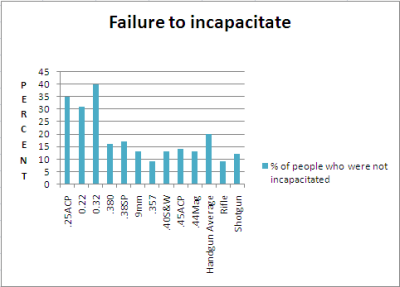
Percentage of People Not Incapacitated
40%-.32 Long, ACP
35%-.25 ACP
31%-.22 LR, Long, Short
17%-.38 Special
16%-.380 ACP
14%-.45 ACP
13%-9mm Lugar
13%-.40 S&W
13%-.44 Magnum
12%-Shotgun(All, 90% 12 Gauge
9%-.357(Magnum & Sig)
9%-Rifle(centerfire)
.25 ACP
# of people shot - 68
# of hits - 150
% of hits that were fatal - 25%
Average number of rounds until incapacitation - 2.2
% of people who were not incapacitated - 35%
One-shot-stop % - 30%
Accuracy (head and torso hits) - 62%
% actually incapacitated by one shot (torso or head hit) - 49%
.22 (short, long and long rifle)
# of people shot - 154
# of hits - 213
% of hits that were fatal - 34%
Average number of rounds until incapacitation - 1.38
% of people who were not incapacitated - 31%
One-shot-stop % - 31%
Accuracy (head and torso hits) - 76%
% actually incapacitated by one shot (torso or head hit) - 60%
.32 (both.32 Long and.32 ACP)
# of people shot - 25
# of hits - 38
% of hits that were fatal - 21%
Average number of rounds until incapacitation - 1.52
% of people who were not incapacitated - 40%
One-shot-stop % - 40%
Accuracy (head and torso hits) - 78%
% actually incapacitated by one shot (torso or head hit) - 72%
.380 ACP
# of people shot - 85
# of hits - 150
% of hits that were fatal - 29%
Average number of rounds until incapacitation - 1.76
% of people who were not incapacitated - 16%
One-shot-stop % - 44%
Accuracy (head and torso hits) - 76%
% actually incapacitated by one shot (torso or head hit) - 62%
9mm Luger
# of people shot - 456
# of hits - 1121
% of hits that were fatal - 24%
Average number of rounds until incapacitation - 2.45
% of people who were not incapacitated - 13%
One-shot-stop % - 34%
Accuracy (head and torso hits) - 74%
% actually incapacitated by one shot (torso or head hit) - 47%
.38 Special
# of people shot - 199
# of hits - 373
% of hits that were fatal - 29%
Average number of rounds until incapacitation - 1.87
% of people who were not incapacitated - 17%
One-shot-stop % - 39%
Accuracy (head and torso hits) - 76%
% actually incapacitated by one shot (torso or head hit) - 55%
.357 (both magnum and Sig)
# of people shot - 105
# of hits - 179
% of hits that were fatal - 34%
Average number of rounds until incapacitation - 1.7
% of people who were not incapacitated - 9%
One-shot-stop % - 44%
Accuracy (head and torso hits) - 81%
% actually incapacitated by one shot (torso or head hit) - 61%
.40 S & W
# of people shot - 188
# of hits - 443
% of hits that were fatal - 25%
Average number of rounds until incapacitation - 2.36
% of people who were not incapacitated - 13%
One-shot-stop % - 45%
Accuracy (head and torso hits) - 76%
% actually incapacitated by one shot (torso or head hit) - 52%
.45 ACP
# of people shot - 209
# of hits - 436
% of hits that were fatal - 29%
Average number of rounds until incapacitation - 2.08
% of people who were not incapacitated - 14%
One-shot-stop % - 39%
Accuracy (head and torso hits) - 85%
% actually incapacitated by one shot (torso or head hit) - 51%
.44 Magnum
# of people shot - 24
# of hits - 41
% of hits that were fatal - 26%
Average number of rounds until incapacitation - 1.71
% of people who were not incapacitated - 13%
One-shot-stop % - 59%
Accuracy (head and torso hits) - 88%
% actually incapacitated by one shot (torso or head hit) - 53%
Rifle (all Centerfire)
# of people shot - 126
# of hits - 176
% of hits that were fatal - 68%
Average number of rounds until incapacitation - 1.4
% of people who were not incapacitated - 9%
One-shot-stop % - 58%
Accuracy (head and torso hits) - 81%
% actually incapacitated by one shot (torso or head hit) - 80%
Shotgun(All,but 90% of results were 12 gauge)
# of people shot - 146
# of hits - 178
% of hits that were fatal - 65%
Average number of rounds until incapacitation - 1.22
% of people who were not incapacitated - 12%
One-shot-stop % - 58%
Accuracy (head and torso hits) - 84%
% actually incapacitated by one shot (torso or head hit) - 86%
48000 ft⋅lbf 20mm Vulcan(20×102mm),2000 grain,3300 fps 2000 grain/4.6 oz.
BASEBALL BALLISTICS
Baseball diameter=7.6 cm Baseball radius=3.8 cm Baseball volume=229 cm Baseball weight=149 grams 89 ft/lbs: Baseball(Pitch) @ 90mph/132 fps 120 ft/lbs: Aguila SSS Sniper Subsonic Ammunition 22 Long Rifle 60 Grain 950 fps 186 ft/lbs: Baseball(Hit)130mph/190 fps 204 ft/lbs:Aguila Super Maximum 22 Long Rifle 30 Grain Hyper Velocity Plated Lead Hollow Point Lead Density=11.34 grams/cubic centimeter Lead Baseball weight=2596 grams /5.723 Pounds /91.56 ounces 1609 ft/lbs: Lead Baseball @90mph/132 fps 3510 ft/lbs tackle by football player of 262.5 pounds at 20 mph/29.3333 fps 1546 ft/lbs 4000 pound car at 3.4 mph/4.98667fps 3342 ft/lbs 4000 pound car at 5 mph/7.33fps 30082 ft/lbs 4000 pound car at 15 mph/22fps 38639 ft/lbs 4000 pound car at 17 mph/24.93333fps [20mm] 53479 ft/lbs 4000 pound car at 20 mph/29.33fps 83561 ft/lbs 4000 pound car at 25 mph/36.67fps 120328 ft/lbs 4000 pound car at 30mph/44fps 163780 ft/lbs 4000 pound car at 35 mph/51.33fps 213917 ft/lbs 4000 pound car at 40 mph/58.67fps
334293 ft/lbs 4000 pound car at 50mph/73.34fps 404437 ft/lbs 4000 pound car at 55mph/80.67fps 481313 ft/lbs 4000 pound car at 60 mph/88fps 752052 ft/lbs 4000 pound car at 75 mph/110fps